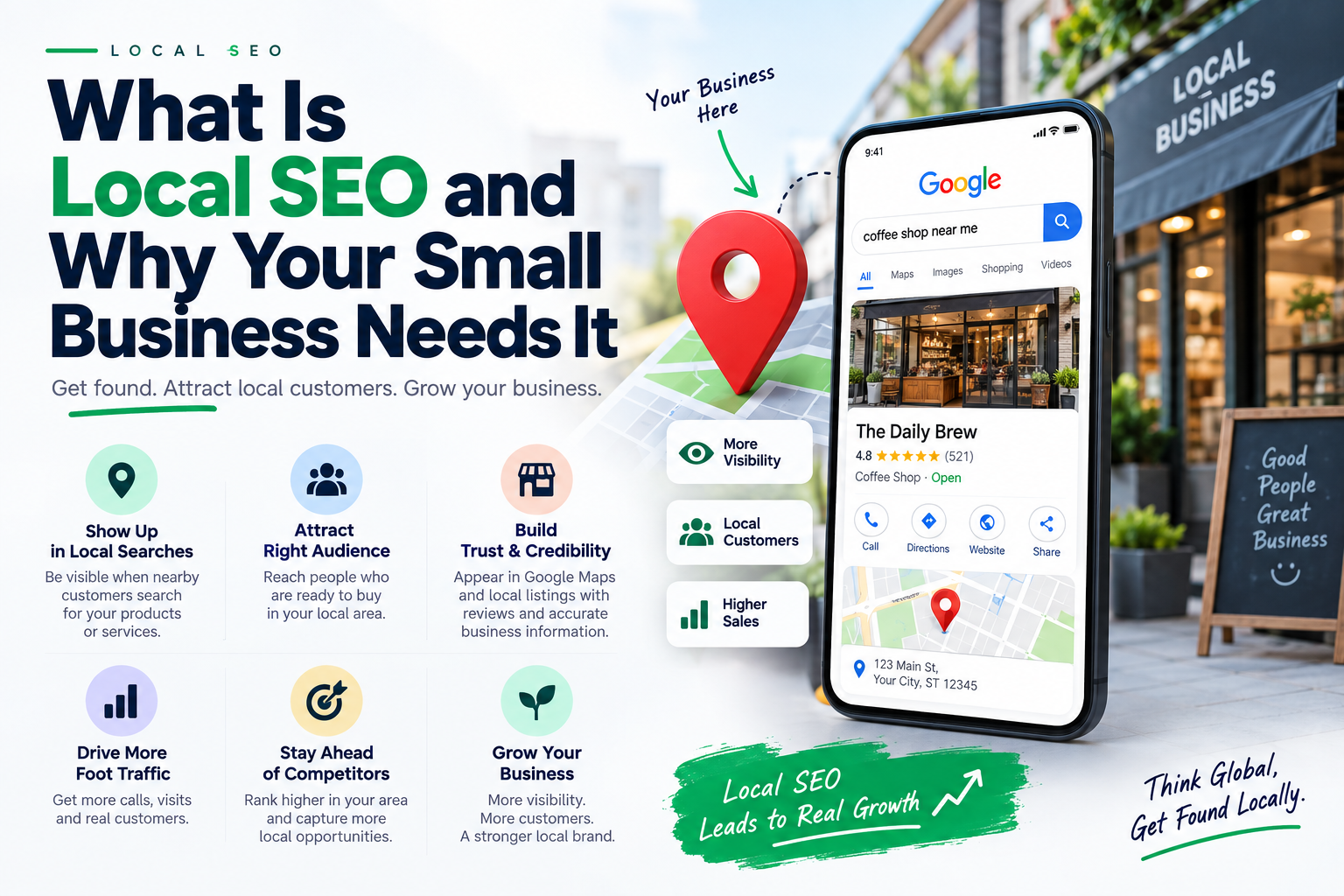
What Is Local SEO and Why Your Small Business Needs It
Local SEO is the practice of optimizing your online presence so your business shows up when nearby customers search for what you offer — think “plumber near me” or “best coffee shop in [city].” For small businesses with a physical location or a defined service area, it’s often the single highest-return marketing investment available, because the people searching are already looking to buy, not just browse.
If you’ve ever searched for a business “near me” and picked from the map results at the top of Google, you’ve already experienced local SEO in action — you just didn’t see the work behind it.
What Local SEO Actually Means
Local SEO is a specific branch of SEO focused on ranking for location-based searches. Instead of competing to rank for a broad term like “digital marketing agency” against thousands of websites worldwide, local SEO helps you rank for “digital marketing agency in Austin” — a search with far less competition and far more buying intent.
It centers on three main things:
Google Business Profile — your business listing that shows up in Google Maps and the local “map pack” at the top of search results.
On-site local signals — location pages, city/service mentions, and structured data that tell search engines exactly where you operate.
Citations and reviews — consistent business information across directories (name, address, phone number) and genuine customer reviews, both of which build trust with Google and with searchers.
Why It Matters More for Small Businesses Than Big Brands
A national brand can afford to compete for broad, expensive keywords. A small business usually can’t — and doesn’t need to. Local SEO lets a small business compete on a much fairer playing field, because the competition is limited to other businesses in the same city or region, not the entire internet.
It also targets exactly the kind of customer a small business wants: someone nearby, ready to visit, call, or buy today. A person searching “emergency electrician near me” isn’t researching — they’re about to hire someone in the next hour.
What Happens Without Local SEO
Without it, a business becomes invisible in the exact moment it matters most. A potential customer searches, sees three or four competitors in the map pack, and picks one of them — often without ever scrolling further or considering who might have the better product or service. Being absent from that map pack doesn’t mean losing to a better competitor; it often means losing to a competitor who simply set up their Google Business Profile correctly.
What Local SEO Involves, In Practice
Claiming and fully completing your Google Business Profile — accurate hours, categories, photos, and services.
Getting listed consistently across directories like Yelp, Bing Places, and industry-specific listings, with the same business name, address, and phone number everywhere.
Collecting and responding to reviews — both the volume and the way a business responds matter to potential customers and to Google.
Creating location-specific content — a dedicated page for each city or service area a business serves, rather than one generic page trying to rank everywhere.
On-page local signals — mentioning the city/region naturally in titles, headers, and content, and adding local business schema markup.
How to Know If You Need Local SEO
If your business relies on customers finding you locally — a clinic, a restaurant, a home service provider, a local retailer, or even a regional agency — local SEO isn’t optional. The simplest test: search for what you do plus your city on Google right now. If you don’t see your business in the first few map results, you’re losing customers to competitors who do.