Reviews have the biggest impact on local SEO — rankings in the map pack and "near me" searches. National or ecommerce SEO relies more on backlinks, content, and technical factors, though reviews can still support overall trust signals.

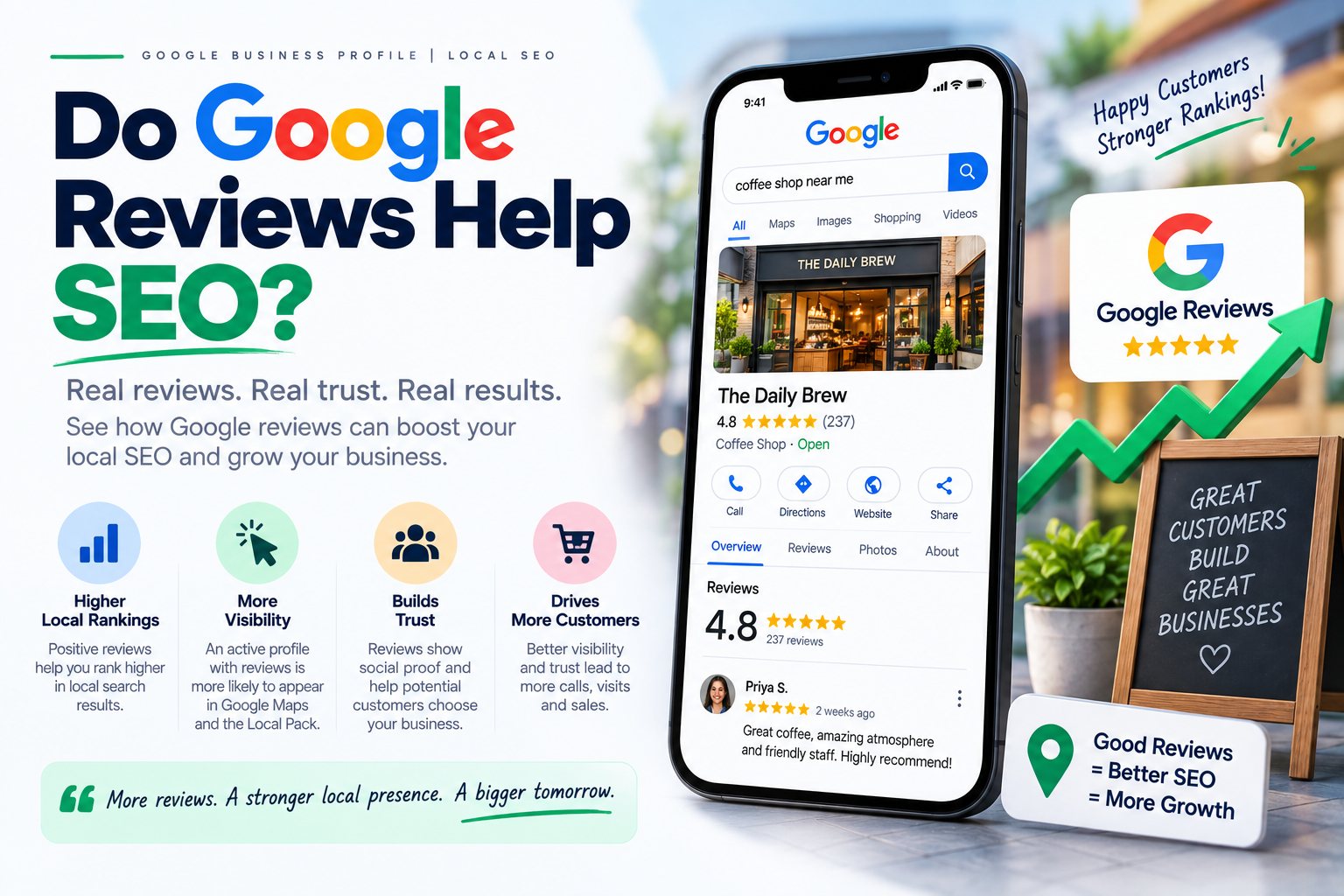
Yes, Google reviews help SEO — particularly local SEO. Review count, average rating, review recency, and how often a business responds all factor into how Google ranks a business in local search results and the map pack. They won’t fix a technically broken website on their own, but for any business competing on local visibility, reviews are one of the more controllable ranking factors available.
If you’ve ever wondered why a competitor with a less polished website still outranks you in the local map pack, reviews are often a big part of the answer — and it’s one of the few ranking factors a business can influence directly, without needing technical SEO expertise.
Google has stated that reviews are one of the signals used to rank local businesses, alongside relevance and distance. The mechanism isn’t mysterious: Google wants to show searchers businesses that other real customers have vouched for, and reviews are the clearest signal of that. A business with strong, consistent reviews tends to be treated as more trustworthy and relevant than a similar business with few or no reviews.
This is a big part of why Google reviews and SEO are so closely linked for local businesses specifically — general (non-local) SEO doesn’t weigh reviews nearly as heavily, since a national ecommerce brand ranking for a broad keyword isn’t competing in the same way a local business is for “near me” searches.
Not all review activity carries equal weight. Based on how Google’s local ranking systems behave, a few factors consistently stand out:
This is a common point of confusion. In practice, both matter, but they work together rather than one clearly outweighing the other. A business with 200 reviews at 3.5 stars and a business with 20 reviews at 5 stars can both perform differently depending on the market and competition — volume builds trust and signals an established presence, while rating reflects actual service quality. The businesses that perform best in local search tend to have a healthy combination of both: a solid volume of reviews and a strong average rating maintained over time.
Even setting rankings aside, reviews directly affect whether a ranked business actually gets clicked. Two businesses can sit next to each other in the local map pack, and the one with more reviews and a better rating will almost always get more clicks and calls. In that sense, reviews influence not just whether you show up, but whether showing up actually turns into business.
The businesses that benefit most from reviews aren’t the ones chasing a number — they’re the ones that make asking for reviews a normal part of doing business. A few things that consistently work:
Reviews aren’t a replacement for a solid SEO foundation — a business still needs a properly optimized Google Business Profile, accurate local citations, and a functional website. But among the factors a business can influence directly and relatively quickly, reviews are one of the most accessible, and consistently one of the most impactful for local visibility.
Reviews have the biggest impact on local SEO — rankings in the map pack and "near me" searches. National or ecommerce SEO relies more on backlinks, content, and technical factors, though reviews can still support overall trust signals.
A few negative reviews, especially ones responded to professionally, don't significantly hurt rankings. What matters more is the overall pattern — consistently poor ratings or an inactive review profile can hurt both rankings and click-through rates.
There's no fixed number, but businesses generally start seeing a meaningful local SEO benefit once they build a steady base of reviews (often 10 or more) with an average rating above 4 stars, and continue growing that base over time.
Responding to reviews doesn't directly move rankings the way review volume or rating does, but it signals an active, engaged business — which supports both trust with customers and Google's broader assessment of the business's activity.
No — Google actively identifies and removes fake or incentivized reviews, and businesses caught doing this risk penalties and reputational damage that far outweigh any short-term ranking gain.

Grow Your Business with Result-Driven SEO & Digital Marketing Solutions. We Help Brands Increase Rankings, Traffic, and Quality Leads Organically.
| Monday | 9:30 AM - 6:30 PM |
| Tuesday | 9:30 AM - 6:30 PM |
| Wednesday | 9:30 AM - 6:30 PM |
| Thursday | 9:30 AM - 6:30 PM |
| Friday | 9:30 AM - 6:30 PM |
| Saturday | 9:30 AM - 6:30 PM |
| Sunday | Closed |
©Copyright @ 2026 RankPluto. | All Right Reserved
This will close in 0 seconds