
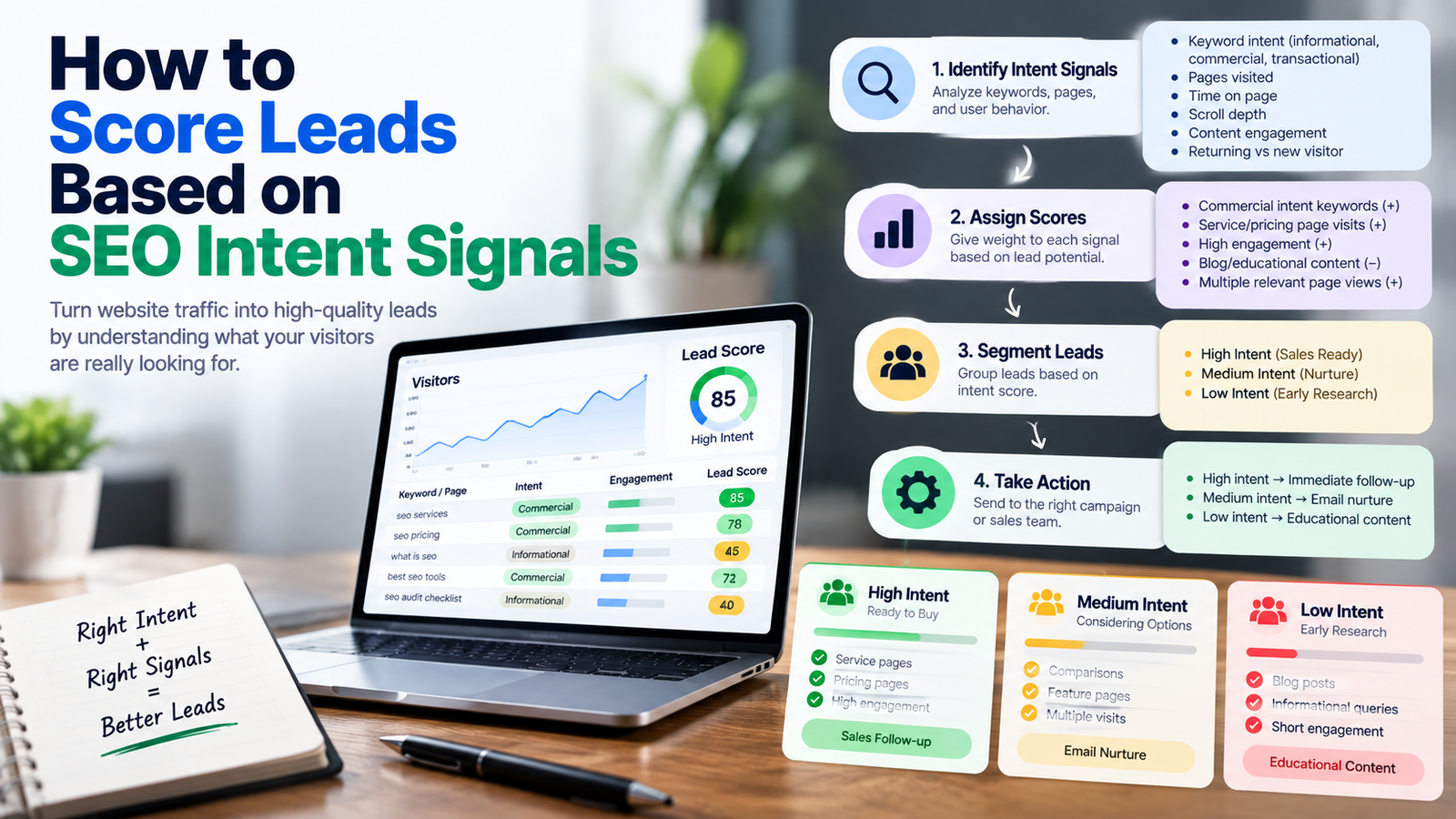
To score leads based on SEO intent signals, weight each lead by the search intent behind the keyword that brought them in, the specific page they landed on, and how they behaved once there. A lead who searched “SEO pricing” and filled out a form on a packages page is a fundamentally different opportunity than one who landed on a general blog post from an informational search — and treating them the same in a sales pipeline wastes time on both ends.
Most businesses collect plenty of organic leads without ever separating the ones ready to buy from the ones just researching. Search intent — something already baked into the keyword that brought each visitor to the site — is one of the most underused signals for fixing that.
Every keyword carries intent, whether informational (“what is local SEO”), commercial (“best SEO agency for small business”), or transactional (“SEO packages pricing”). A visitor arriving through a transactional keyword has already moved much further down the decision-making process than one arriving through a purely informational one — even if both end up filling out the same contact form.
Traditional lead scoring often looks at firmographics (company size, industry, job title) or engagement (email opens, page visits) without factoring in the intent that brought the lead to the site in the first place. Adding search intent and lead scoring together closes that gap, giving sales teams a much clearer signal of how close a lead actually is to being ready.
A practical model for SEO lead qualification usually combines three layers of signal:
1. Keyword intent tier: Classify the keyword (or search query, where available through analytics) into a tier:
2. Landing page type: The page a visitor first lands on carries its own signal, separate from the keyword. A visitor landing directly on a pricing or packages page — regardless of exactly which keyword brought them — tends to convert at a higher rate than one landing on a general blog post, even a well-targeted one.
3. On-site behavior: Once intent and landing page are factored in, actual behavior refines the score further: visiting a pricing page after reading a blog post, spending several minutes on a service page, or returning to the site multiple times before converting are all signals worth weighting higher than a single, brief visit.
A basic intent-based lead scoring model might look like this:
This isn’t a rigid formula — the specific weighting should reflect what a business has actually observed about which lead sources convert. But the structure of tying score to intent, not just to demographic or engagement data alone, tends to significantly improve how efficiently a sales team spends its time.
Paid search leads often come with more built-in intent context, since ad campaigns are usually built around specific, already-defined keyword targets. Organic lead scoring benefits even more from an intent-based model, because organic traffic naturally spans a much wider range of search intent — from someone in the earliest stages of research to someone actively comparing vendors — and without separating them, sales teams risk treating a curious researcher the same as a ready buyer.
A few patterns tend to undermine an otherwise good intent-based model:
A full marketing automation platform makes this easier to scale, but it’s not required to start. Even a simple spreadsheet tagging each lead’s source keyword, landing page, and first action is enough to begin separating high-intent leads from early-stage ones — and refining the model as real conversion patterns emerge.
Want help turning organic traffic into a qualified lead pipeline? Talk to RankPluto about lead-focused SEO →
Intent-based lead scoring prioritizes leads according to the search intent behind the keyword that brought them to a site — transactional, commercial, or informational — rather than relying only on demographic or engagement data.
Search Console and analytics tools can show which query led to a visit. Even without exact keyword data, the landing page a visitor arrives on is often a reliable proxy for intent.
No. Informational leads are earlier in the buying process, but many eventually convert. They should be scored lower than transactional leads, but still nurtured rather than discarded.
No — it works best as an added layer alongside firmographic and engagement-based scoring, giving a more complete picture of how ready a lead actually is.
Google Search Console and Analytics provide the underlying keyword and landing page data; CRM or marketing automation platforms can then apply scoring rules based on that data, though a simple spreadsheet works for getting started.

Grow Your Business with Result-Driven SEO & Digital Marketing Solutions. We Help Brands Increase Rankings, Traffic, and Quality Leads Organically.
| Monday | 9:30 AM - 6:30 PM |
| Tuesday | 9:30 AM - 6:30 PM |
| Wednesday | 9:30 AM - 6:30 PM |
| Thursday | 9:30 AM - 6:30 PM |
| Friday | 9:30 AM - 6:30 PM |
| Saturday | 9:30 AM - 6:30 PM |
| Sunday | Closed |
©Copyright @ 2026 RankPluto. | All Right Reserved
This will close in 0 seconds