
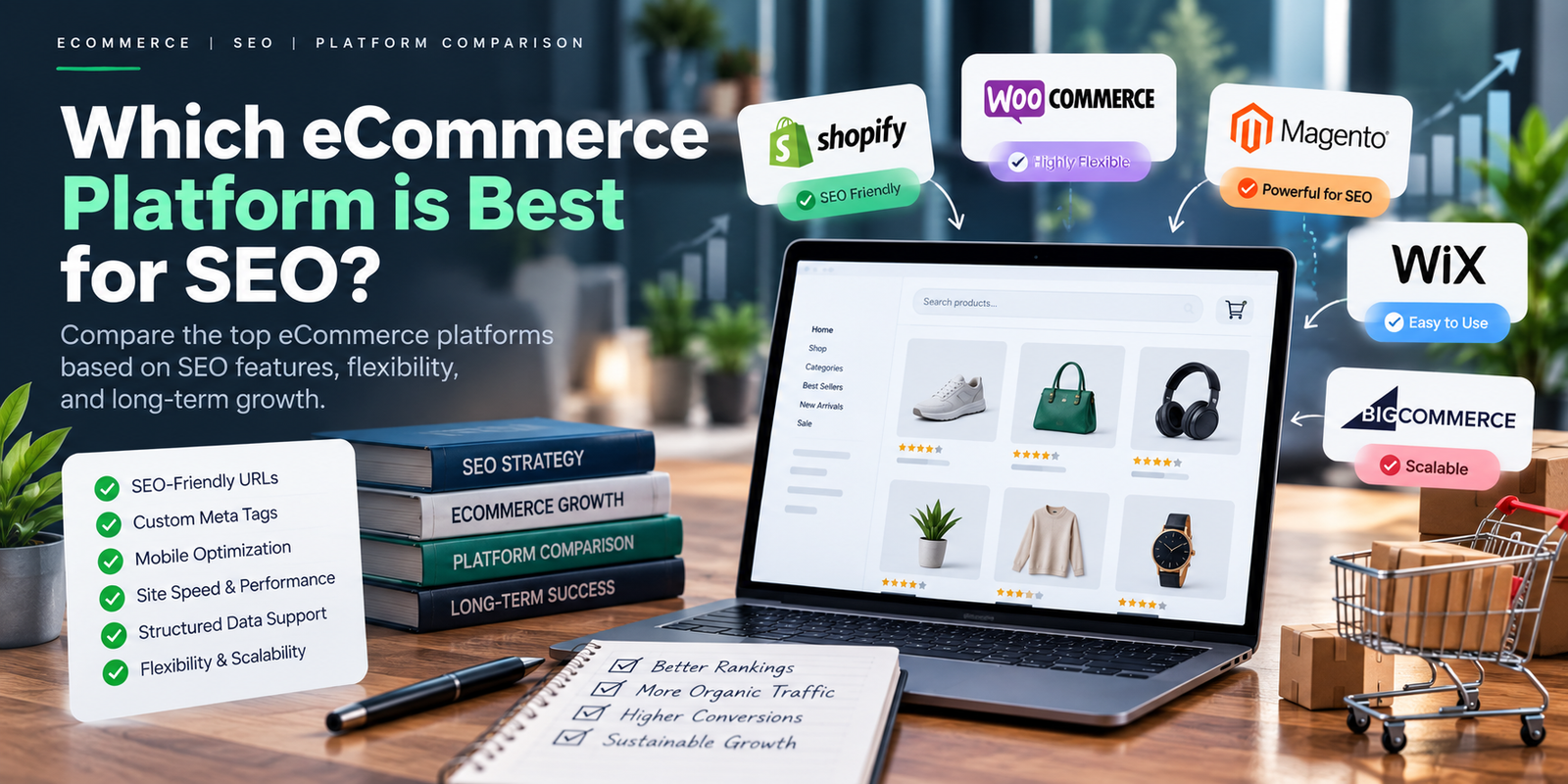
WooCommerce generally offers the most SEO flexibility since it’s built on WordPress and gives full control over structure, plugins, and technical settings. Shopify is close behind, with strong built-in performance and much less technical maintenance, but slightly less flexibility for advanced technical SEO. BigCommerce and Magento both suit larger stores, with Magento offering the deepest customization at the cost of significantly more technical overhead. There’s no single “best” platform — the right choice depends on store size, technical resources, and how much control you actually need.
If you’re choosing a platform before launching a store, it’s worth getting this decision right the first time — migrating an established ecommerce site later, without losing rankings, is one of the more disruptive projects in SEO.
Before comparing specific platforms, it helps to know what actually matters for SEO in an ecommerce context:
Shopify is widely used for a reason: it’s fast out of the box, handles hosting and security without any technical setup, and has a large app ecosystem for adding SEO features. Its URL structure has some fixed elements (like /products/ or /collections/ prefixes) that can’t be fully customized, which is the most common SEO criticism of the platform. For most small to mid-sized stores, though, this limitation has a minimal real-world impact compared to the platform’s speed and ease of use.
Best for: Store owners who want strong performance without managing hosting, plugins, or technical maintenance themselves.
WooCommerce runs on WordPress, which means it inherits WordPress’s full flexibility — custom URL structures, any SEO plugin (Yoast, Rank Math), and complete control over site architecture. This is usually the deciding factor in the Shopify vs WooCommerce SEO comparison: WooCommerce offers more control, but that control comes with more responsibility — hosting, security, and performance optimization all fall on the store owner or their developer.
Best for: Businesses with some technical resources (in-house or agency support) who want maximum SEO flexibility and don’t mind managing more of the technical side themselves.
BigCommerce sits between Shopify and WooCommerce in terms of flexibility — more customizable URL structure than Shopify, built-in performance similar to Shopify, without requiring the same level of hands-on technical management as WooCommerce. It also includes solid native SEO features (customizable meta fields, automatic sitemaps) without needing third-party apps for the basics.
Best for: Growing or mid-to-large stores that want more SEO control than Shopify without taking on WooCommerce’s full technical overhead.
Magento offers the deepest level of customization of any platform on this list — nearly everything about site structure, URLs, and technical SEO can be configured exactly as needed. That power comes at a real cost: Magento typically requires dedicated developer resources to set up, maintain, and keep performing well, since a poorly configured Magento store can actually perform worse for SEO than a well-configured Shopify or WooCommerce store.
Best for: Large, complex catalogs or enterprise stores with the development budget to properly manage the platform.
For most small to mid-sized businesses, the realistic choice comes down to Shopify or WooCommerce. If ease of use and speed with minimal technical management matter most, Shopify is usually the better fit. If maximum SEO control matters more, and there’s some technical support available, WooCommerce tends to edge ahead. Larger stores with more complex catalogs are better served by BigCommerce or Magento, where the added flexibility becomes genuinely necessary rather than optional.
It’s worth saying clearly: platform choice affects SEO, but execution matters more. A well-optimized Shopify store will consistently outrank a poorly optimized WooCommerce or Magento store. Product descriptions, technical SEO fundamentals, backlinks, and content strategy all have a bigger cumulative impact than which platform a store happens to run on — the platform sets the ceiling, but the actual work determines how close a store gets to it.
WooCommerce generally offers more SEO flexibility and URL control, since it's built on WordPress. Shopify offers strong built-in speed and much less technical maintenance. The better choice depends on available technical resources.
It can, if not managed carefully. Migrating platforms risks losing rankings through broken URLs, lost redirects, or content changes — proper 301 redirects and a careful migration plan are essential to preserve existing SEO performance.
Shopify is often the best starting point for small businesses, thanks to its speed, low technical maintenance, and solid built-in SEO features, unless the business specifically needs WooCommerce's deeper customization.
Magento can be excellent for SEO due to its deep customization options, but only with proper technical setup and ongoing maintenance — a poorly managed Magento store can underperform compared to simpler platforms.
Yes, indirectly — through site speed, URL structure, and how easily structured data (like product schema) can be added — but content quality and backlinks typically have a larger direct impact on individual product page rankings.

Grow Your Business with Result-Driven SEO & Digital Marketing Solutions. We Help Brands Increase Rankings, Traffic, and Quality Leads Organically.
| Monday | 9:30 AM - 6:30 PM |
| Tuesday | 9:30 AM - 6:30 PM |
| Wednesday | 9:30 AM - 6:30 PM |
| Thursday | 9:30 AM - 6:30 PM |
| Friday | 9:30 AM - 6:30 PM |
| Saturday | 9:30 AM - 6:30 PM |
| Sunday | Closed |
©Copyright @ 2026 RankPluto. | All Right Reserved
This will close in 0 seconds