What Is White Hat and Black Hat SEO?
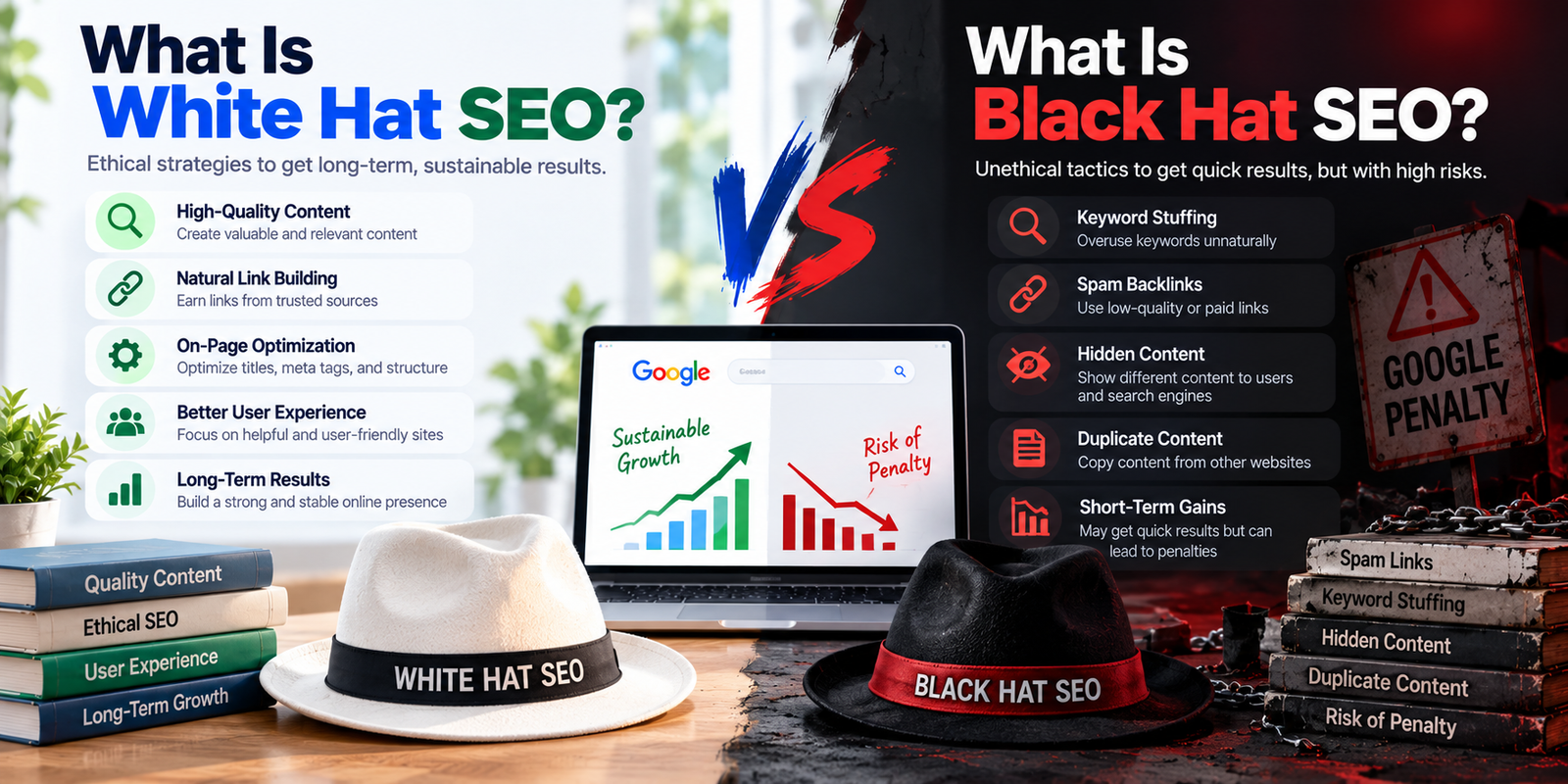
White hat SEO follows search engine guidelines to build genuine, sustainable rankings — through quality content, legitimate backlinks, and good site experience. Black hat SEO uses tactics that break those guidelines to try to rank faster, such as keyword stuffing, hidden text, or buying bulk links — tactics that carry a real risk of penalties, ranking drops, or a site being removed from search results entirely.
The terms borrow their names from old Western movies, where the “good guy” wore a white hat and the “villain” wore black. In SEO, the metaphor has stuck because it captures something real: one approach plays by the rules for long-term gain, and the other tries to exploit the system for a faster, riskier payoff.
White Hat SEO: Playing by the Rules
White hat SEO techniques are built around one core idea — actually deserving the ranking, not just gaming an algorithm into granting it. This includes:
- Creating genuinely useful, original content that answers what a searcher is actually looking for.
- Earning backlinks naturally — through content worth linking to, relationships, and outreach, not paid or manipulated links.
- Optimizing technical site health — fast load times, mobile-friendliness, clean site structure, and proper use of meta tags and schema.
- Improving user experience — easy navigation, clear calls to action, and content that keeps visitors engaged rather than bouncing immediately.
The tradeoff is time. White hat SEO tends to take months to show significant results, since it’s built on the same kind of trust-building that search engines are specifically designed to require before ranking a site highly.
Black Hat SEO: Trying to Shortcut the System
Black hat SEO techniques attempt to manipulate search rankings in ways that violate search engine guidelines, usually chasing faster results. Common examples include:
- Keyword stuffing — unnaturally repeating a phrase throughout content purely to manipulate rankings, rather than to communicate clearly.
- Cloaking — showing search engines different content than what a real visitor actually sees.
- Hidden text or links — text or links styled to be invisible to users but still readable by search engine crawlers.
- Buying or exchanging large volumes of links — building backlinks through link farms or paid schemes rather than earning them naturally.
- Content scraping or spinning — copying content from other sites and lightly rewording it to appear original.
The Real Risks of Black Hat SEO
The appeal of black hat SEO is speed — these tactics can sometimes produce a quick ranking jump. The black hat SEO risks, though, are significant and often disproportionate to the short-term gain:
- Manual penalties — Google’s search quality team can manually review and penalize a site found using manipulative tactics, sometimes removing it from search results entirely.
- Algorithmic detection — search engines continuously update algorithms specifically designed to detect and demote sites using these patterns, meaning a tactic that works today may trigger a penalty months later.
- Recovery is slow and difficult — once a site is penalized, recovering lost rankings and trust can take far longer than the time originally “saved” by using black hat tactics.
- Reputational damage — for an agency using these tactics on client sites, the fallout extends beyond the algorithm to trust with the client whose business was put at risk.
Where Grey Hat SEO Fits In
Grey hat SEO sits in the ambiguous middle — tactics that aren’t explicitly against search engine guidelines but push close to the line, exploiting loopholes or gaps in how algorithms are enforced rather than clearly violating stated rules. Buying an expired domain purely for its existing backlinks, or aggressive but technically-within-guidelines link exchanges, are common examples. The risk with grey hat tactics is that guidelines and enforcement evolve — what’s a loophole today can become an explicitly penalized tactic tomorrow, with little warning.
Why White Hat SEO Wins in the Long Run
The white hat vs black hat SEO comparison usually comes down to a simple tradeoff: speed versus durability. Black hat tactics can occasionally produce fast results, but they carry constant risk and rarely hold up over time as detection improves. White hat SEO takes longer to show results, but those results tend to compound and remain stable, without the constant risk of a sudden penalty erasing months or years of progress overnight.
For any business planning to operate for the long term — rather than chasing a quick, disposable ranking spike — white hat SEO techniques remain the only approach that reliably builds an asset rather than a liability.