
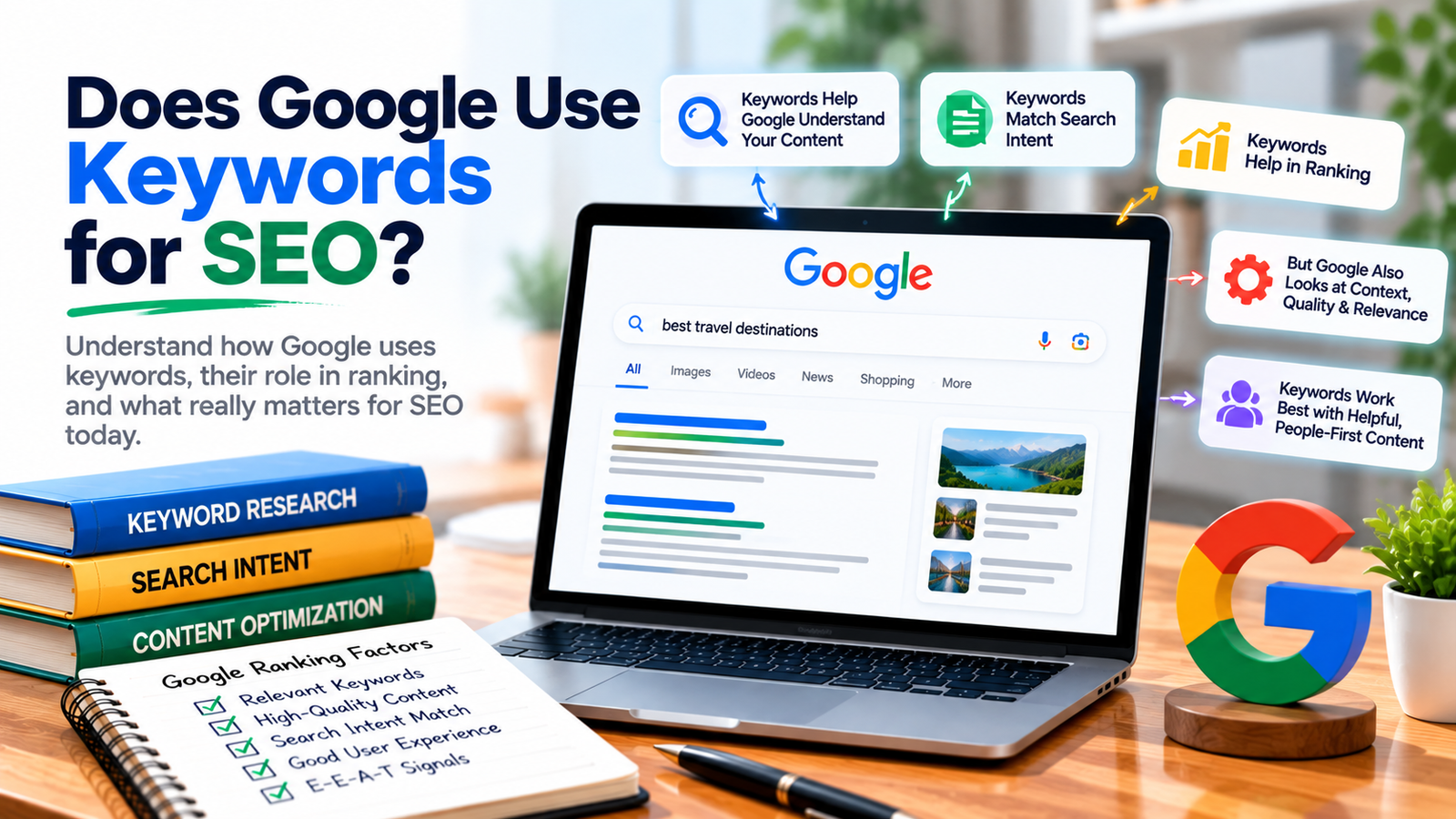
Yes, Google still uses keywords for SEO — but not in the simple, literal way it did in the early days of search. Instead of just scanning a page for exact-match text, Google now interprets keywords as signals of meaning and intent, using natural language understanding to figure out what a page is actually about, even when the exact search phrase never appears word-for-word on the page.
If you’ve ever ranked for a phrase you never actually typed anywhere in your content, that’s not a glitch — that’s exactly how modern keyword matching works.
In early search engines, keywords functioned almost like a literal lookup — a page ranked for a phrase largely based on how often that exact phrase appeared on the page. This is the era that produced keyword stuffing as a real, effective (if short-lived) tactic, since simply repeating a phrase more often could genuinely move rankings. It’s also why so much outdated SEO advice still focuses on hitting a specific keyword count or density.
Modern Google relies heavily on natural language processing to understand context and meaning, not just literal word matches. This shift became especially pronounced after updates like BERT and later systems focused specifically on understanding language the way humans actually use it — including synonyms, related concepts, and the intent behind a phrase, not just its literal text.
Practically, this means Google can recognize that “affordable web design” and “cheap website development” relate to a similar underlying need, even though the words don’t match exactly. A page thoroughly covering the topic of budget-friendly web design can rank for both phrasings, without ever containing the exact string “cheap website development.”
This is really the core of the question. Google’s systems are built to understand context — the relationship between words, the likely intent behind a search, and how a page’s overall content relates to that intent. A search for “apple” returns very different results depending on surrounding context clues in a longer query, which wouldn’t be possible with simple keyword matching alone. This context-driven approach is also central to how Google’s AI Overviews and other AI-assisted search features work, since generating a coherent answer requires understanding meaning, not just locating a matching phrase somewhere on a page.
Yes, but with a caveat. Exact match keywords SEO practices still have value — using the actual phrase a person is likely to search for, especially in a title, heading, or early in a piece of content, remains a clear and direct relevance signal. The difference is that exact matching is no longer the primary mechanism driving rankings; it’s one signal among many, working alongside content depth, related terminology, and overall topical coverage.
Since Google use keywords for SEO purposes through meaning rather than literal matching, the practical implication is straightforward: writing to thoroughly and clearly answer a topic naturally produces the kind of keyword and semantic coverage Google’s systems look for, without needing to obsess over hitting an exact phrase a specific number of times. A page that genuinely, thoroughly covers “how to choose a web design agency” will likely rank for dozens of related phrasings and questions, simply because thorough content naturally covers the language variations real people use.
Context understanding hasn’t eliminated the value of keywords entirely — it’s shifted where they matter most:
The keywords still matter — what’s changed is that they now work as part of a broader understanding of meaning, not as an isolated, literal matching exercise.
Perhaps the most useful mental shift is moving from thinking in individual keywords to thinking in topics. Instead of asking “which exact keyword should this page target,” a more accurate modern question is “what topic and intent is this page fully addressing, and which related phrases naturally fall within that.” This reframing tends to produce content that performs better in modern search — including in AI-generated answers, which similarly rely on topical completeness rather than exact keyword presence.
Exact matches still carry some relevance signal, but Google primarily relies on understanding meaning and context today, meaning a page can rank for phrases it never literally contains, if it thoroughly covers the related topic.
Google uses natural language processing systems, including technologies like BERT, to interpret the relationship between words, synonyms, and the likely intent behind a search — not just a literal string match.
No. Keyword stuffing was effective when search engines relied on literal keyword matching. Modern algorithms are specifically designed to recognize and often penalize this pattern rather than reward it.
Yes — using your target keyword naturally, especially in titles, headings, and early in the content, remains a clear and useful relevance signal, even though it's no longer the sole factor driving rankings.
Semantic search means content should be built around fully covering a topic and its related concepts, rather than narrowly targeting one exact phrase — a shift from keyword-first thinking to topic-first thinking.

Grow Your Business with Result-Driven SEO & Digital Marketing Solutions. We Help Brands Increase Rankings, Traffic, and Quality Leads Organically.
| Monday | 9:30 AM - 6:30 PM |
| Tuesday | 9:30 AM - 6:30 PM |
| Wednesday | 9:30 AM - 6:30 PM |
| Thursday | 9:30 AM - 6:30 PM |
| Friday | 9:30 AM - 6:30 PM |
| Saturday | 9:30 AM - 6:30 PM |
| Sunday | Closed |
©Copyright @ 2026 RankPluto. | All Right Reserved
This will close in 0 seconds