
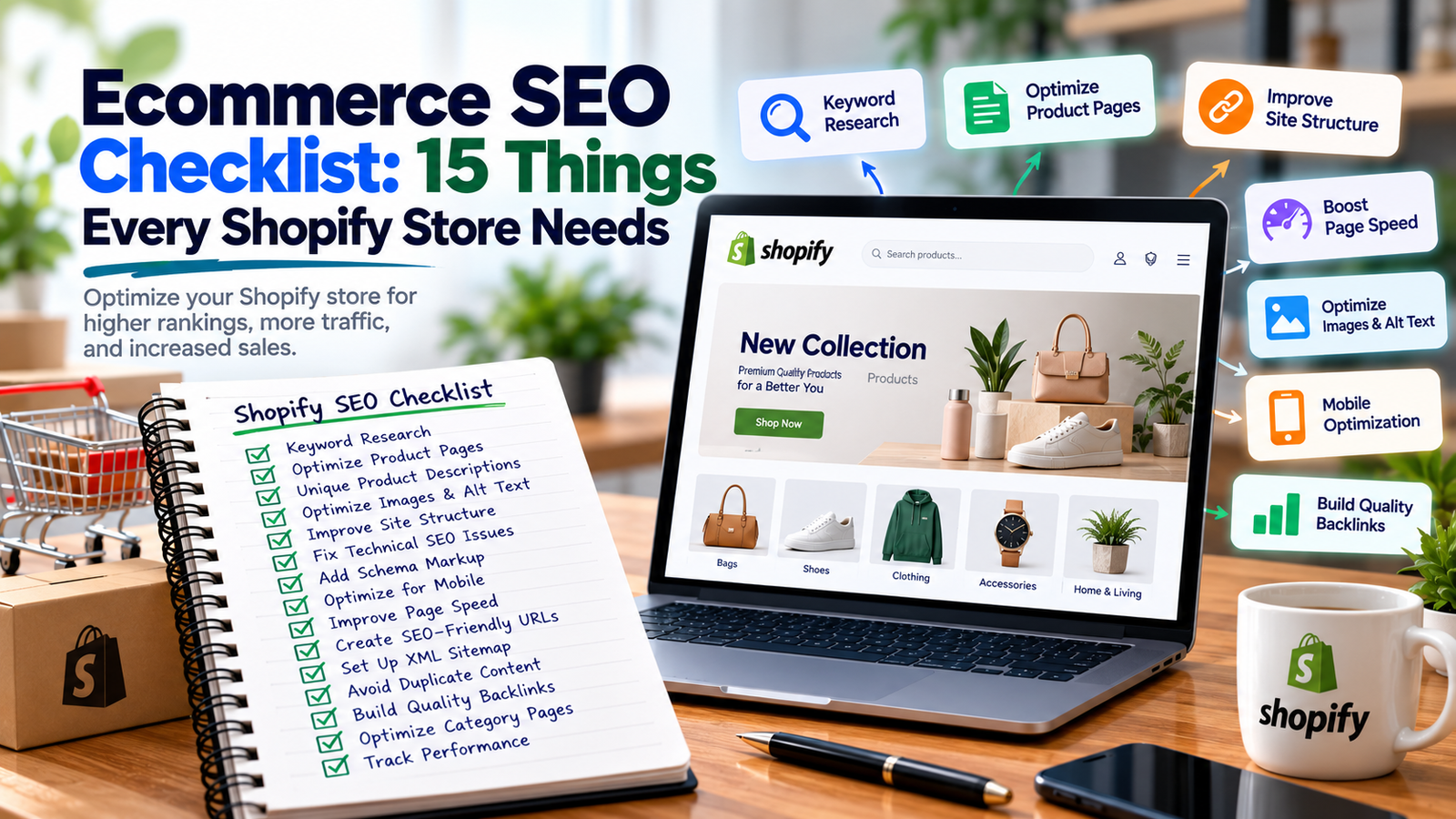
A solid Shopify SEO checklist covers four main areas — technical foundations, product and category page optimization, content, and off-site authority. Below are 15 specific items that consistently separate Shopify stores that rank from ones that don’t, regardless of store size or product category.
Shopify handles a lot of the technical heavy lifting automatically, which is exactly why many store owners assume SEO takes care of itself. It doesn’t — the platform provides the foundation, but the optimization work still has to happen on top of it.
1. Clean, descriptive URLs Shopify’s URL structure includes fixed elements like /products/ or /collections/, but the rest should be clean and keyword-relevant — /products/organic-cotton-tshirt rather than a default string of numbers or characters.
2. Fast page load speed Image-heavy product pages are a common speed bottleneck. Compress product images before upload, and limit the number of heavy apps installed, since each one can add load time across the entire store.
3. Mobile responsiveness Most Shopify themes handle this well by default, but it’s worth actually testing checkout and product pages on a real mobile device, not just assuming the theme covers it.
4. Submitted XML sitemap Shopify auto-generates a sitemap, but it still needs to be submitted to Google Search Console manually — this doesn’t happen automatically just because the file exists.
5. Proper canonical tags on variant and filtered pages Product variants and filtered collection pages can create duplicate content issues. Shopify handles canonicalization reasonably well by default, but it’s worth verifying, especially on stores with heavy filtering options.
6. Unique product descriptions Copying manufacturer descriptions word-for-word is one of the most common ecommerce SEO checklist failures — it creates duplicate content across potentially thousands of other stores selling the same product.
7. Optimized title tags and meta descriptions Every product and collection page needs a unique title and description targeting the specific terms customers search for, not just the product name alone.
8. Image alt text on every product photo This helps both accessibility and image search visibility, and gives search engines context about products that image recognition alone can’t always capture accurately.
9. Structured data (product schema) Product schema enables rich results — star ratings, pricing, and availability shown directly in search results — which significantly improves click-through rate from search.
10. Logical collection/category hierarchy A clear structure (Home > Category > Subcategory > Product) helps both customers navigate and search engines understand how pages relate to each other.
11. A blog that targets informational searches Buying guides, comparison posts, and how-to content capture customers earlier in their research, before they’re ready to search for a specific product by name.
12. Internal links between blog content and product pages A blog post about “how to choose running shoes” should link directly to relevant product or collection pages — connecting informational content to commercial pages strengthens both.
13. Customer reviews on product pages Reviews add fresh, unique content to otherwise static product pages, and also contribute to the trust signals that influence both rankings and conversion.
14. Backlinks from relevant sites Guest posts, product reviews from bloggers, and mentions from industry publications all build the domain authority that helps product and category pages rank for competitive terms.
15. Consistent business listings (if there’s a physical presence) For Shopify stores with a physical location or local pickup option, consistent business information across Google Business Profile and directories supports local search visibility alongside standard ecommerce SEO.
It’s worth being clear about where Shopify’s defaults are genuinely sufficient and where manual Shopify SEO tips are still necessary. Shopify automatically handles basic site speed infrastructure, SSL certificates, and sitemap generation. It does not automatically write unique product descriptions, optimize meta tags per page, add alt text, or build backlinks — all of which require deliberate, ongoing effort regardless of how well the platform itself performs technically.
A few patterns show up repeatedly on underperforming stores:
Partially. Shopify handles core technical infrastructure well — speed, security, sitemaps — but content-level optimization (product descriptions, meta tags, alt text, backlinks) still requires manual, ongoing work.
Unique, well-written product descriptions tend to have an outsized impact, since duplicate manufacturer descriptions are one of the most common reasons similar Shopify stores fail to rank against competitors selling the same products.
Technical items (speed, sitemap, schema) should be checked periodically, roughly every few months. Content items (descriptions, blog posts, reviews) benefit from ongoing, regular attention rather than a one-time setup.
They can. Each installed app can add to page load time, which affects both user experience and technical SEO. It's worth periodically auditing and removing unused apps.
Yes. A blog captures customers earlier in their research process through informational searches, and internal links from blog content to product pages help distribute authority across the store.

Grow Your Business with Result-Driven SEO & Digital Marketing Solutions. We Help Brands Increase Rankings, Traffic, and Quality Leads Organically.
| Monday | 9:30 AM - 6:30 PM |
| Tuesday | 9:30 AM - 6:30 PM |
| Wednesday | 9:30 AM - 6:30 PM |
| Thursday | 9:30 AM - 6:30 PM |
| Friday | 9:30 AM - 6:30 PM |
| Saturday | 9:30 AM - 6:30 PM |
| Sunday | Closed |
©Copyright @ 2026 RankPluto. | All Right Reserved
This will close in 0 seconds