
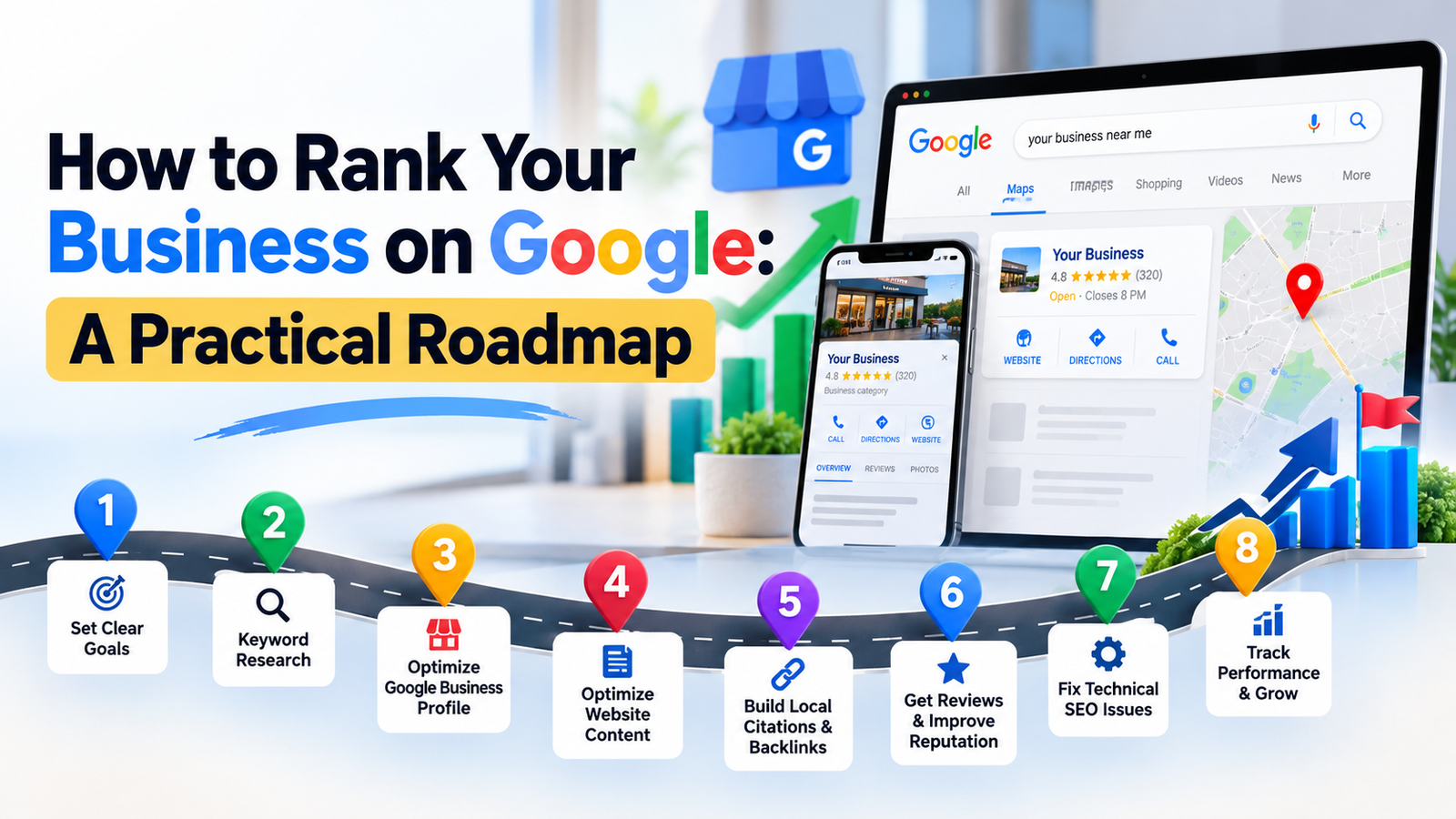
To rank your business on Google, you need to do five things well: set up and complete your Google Business Profile, build a fast and clearly structured website, create content that answers what your customers actually search for, earn genuine reviews, and gain links and mentions from trustworthy sources. None of these works alone, and none produces overnight results — but together they form the foundation almost every business that ranks consistently has in place.
Most business owners know they should be on Google, but few have a clear order of operations. This roadmap puts the steps in the sequence that tends to make sense, so you spend your time on what moves the needle first.
Google’s goal is to show the most helpful, trustworthy result for each search. For a business, that comes down to three broad questions: Is this result relevant to what the person searched? Is the business trustworthy and established? And, for local searches, is it close enough to be useful? Everything in this guide supports one or more of those three questions.
If customers find you by searching for a service in their area, your Google Business Profile is often the single most valuable thing you can set up, and it’s free. Claim your listing, get it verified, choose the most accurate primary category, and fill in your address or service area, hours, phone number, services, and photos. This is what helps you appear on Google Maps and in the local results at the top of the page.
If you want the full walkthrough, we cover it in detail in our guides to local SEO and to setting up a Google Business Profile for Indian businesses.
Even if most of your customers find you through Maps, your website is how Google confirms what you do. The basics matter more than clever tricks:
Ranking for terms nobody searches is wasted effort, and ranking for terms that don’t bring buyers is only slightly better. Start by listing the questions and phrases your customers use when they need what you offer, including how they phrase it in everyday language, not just industry terms. Free tools like Google Search Console (once your site is verified) show what people already search to find you, and Google’s own autocomplete suggestions reveal common phrasing.
Group these searches by intent. Someone searching “emergency plumber near me” is ready to call. Someone searching “how to fix a leaking tap” is researching. Both are valuable, but they call for different pages.
Content is how a website earns visibility beyond its core service pages. Answer real customer questions clearly, put the direct answer near the top, and use simple headings so both readers and search engines can follow the structure. Helpful content also builds trust before a customer ever contacts you.
A practical way to start: write about the ten questions your customers ask most often. If you answer them better than the competition, you give Google a reason to show you.
Reviews influence both whether you rank and whether people choose you once they see you. Ask satisfied customers shortly after a good experience, make it easy with a direct review link, and reply to every review, including critical ones, politely and specifically. Never buy or fake reviews — Google actively works to detect and remove them, and the reputational risk isn’t worth it. We explain how reviews connect to rankings in more detail in our article on whether Google reviews help SEO.
When other credible websites mention or link to your business, it signals that you’re a real, established presence. Good starting points include relevant local and industry directories, local news or community sites, suppliers and partners who can list you, and guest contributions on respected industry blogs. Quality matters far more than quantity — a few relevant, genuine mentions are worth more than hundreds of low-quality links, which can do harm.
Set up Google Search Console and Google Analytics so you can see which searches bring visitors, which pages perform, and where people drop off. Review them monthly, not daily — rankings fluctuate, and trends matter more than single-day changes. Use what you learn to decide what to improve next.
Honest answer: it varies. Local profile improvements can show up sooner, while ranking a website for competitive terms usually takes months of consistent work. Your starting point, your competition, and how consistently you execute all affect the timeline. We break down realistic expectations in our guide to how long SEO takes.
Create and verify a Google Business Profile, make sure your website clearly describes your services and location, and keep your details consistent across the web. This is the foundation for appearing in both Maps and regular search results.
A Google Business Profile alone can help you appear in local results, but a website gives Google more information about your business and gives customers a place to learn more, so most businesses benefit from having both.
There's no fixed timeline. Local visibility can improve within weeks after fixing the basics, while competitive search terms typically take several months of consistent effort.
Appearing in Google's organic results doesn't require paying Google, and a Business Profile is free. Time, content creation, or professional help are the real investments.
A complete, verified Google Business Profile with accurate details and genuine reviews is usually the most impactful starting point for businesses that serve a specific area.

Grow Your Business with Result-Driven SEO & Digital Marketing Solutions. We Help Brands Increase Rankings, Traffic, and Quality Leads Organically.
| Monday | 9:30 AM - 6:30 PM |
| Tuesday | 9:30 AM - 6:30 PM |
| Wednesday | 9:30 AM - 6:30 PM |
| Thursday | 9:30 AM - 6:30 PM |
| Friday | 9:30 AM - 6:30 PM |
| Saturday | 9:30 AM - 6:30 PM |
| Sunday | Closed |
©Copyright @ 2026 RankPluto. | All Right Reserved
This will close in 0 seconds