
PPC doesn’t directly improve organic rankings, but it does provide fast data on which keywords convert — that data can guide which topics to prioritize in your SEO content strategy.
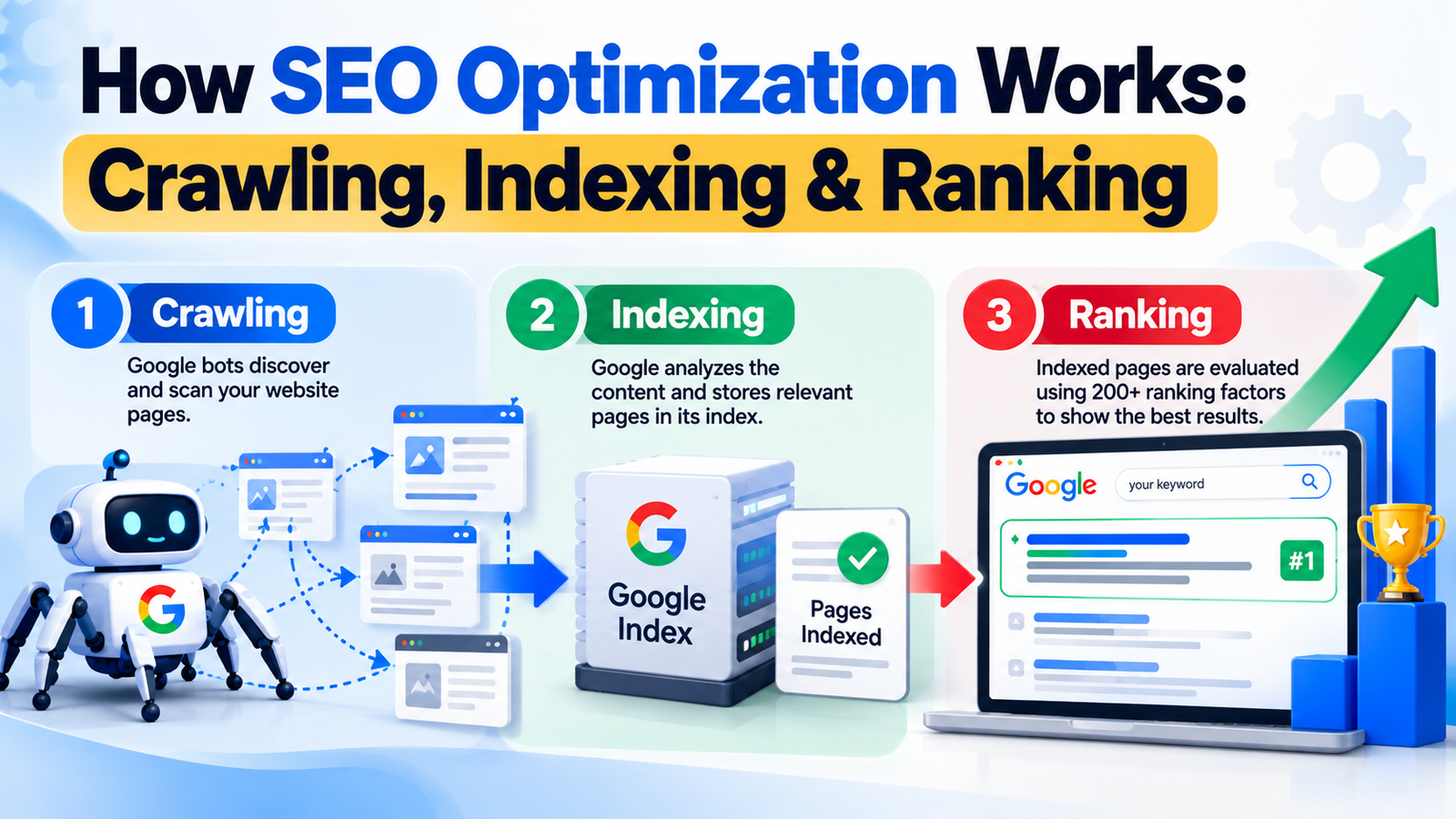
Understanding how SEO optimization works starts with a simple three-stage process. Search engines first crawl the web to discover pages, then index them by storing and understanding their content, and finally rank them by relevance and quality when someone searches. SEO is the work of making your pages easy to crawl, easy to understand, and worth ranking — through technical health, helpful on-page content, and trust signals from elsewhere on the web.
If SEO has ever felt like a collection of unrelated tips, it helps to see the system underneath. Once you understand the stages, most SEO advice starts to make logical sense.
Search engines use automated programs, often called crawlers or bots, to discover pages. They move from link to link, and they also read sitemaps that site owners submit. If a crawler can’t reach a page — because it’s blocked, broken, hidden behind a login, or isolated with no links pointing to it — that page can’t appear in search results at all.
What this means for SEO: Make sure important pages are linked from elsewhere on your site, your sitemap is submitted through Google Search Console, and nothing is accidentally blocking crawlers.
After crawling, the search engine analyzes the page: its text, headings, images, links, and structure, along with signals such as language and location. It then stores information about the page in its index, which is essentially a vast database used to answer searches. Not every crawled page gets indexed — pages that are duplicates, very thin, or low in value may be left out.
What this means for SEO: Clear structure, unique content, and descriptive titles and headings help search engines understand what each page is about and why it deserves a place in the index.
When someone searches, the engine looks through its index and orders results using many signals. Google doesn’t publish the exact list or weights, but its guidance consistently points to a few themes:
Because the exact formula isn’t public, be cautious of anyone who claims to know precise ranking factors or promises guaranteed positions.
Most SEO work falls into three connected areas.
This is the foundation that lets search engines access and understand your site. It includes site speed, mobile-friendliness, secure connections (HTTPS), clean site architecture, sitemaps, and fixing broken links or duplicate pages. If the technical side is weak, strong content can still struggle to perform.
This covers what’s on the page itself: content that matches search intent, clear headings, well-written titles and meta descriptions, descriptive image alt text, and sensible internal links. Good on-page SEO makes it obvious to both visitors and search engines what each page offers.
This covers signals from outside your website — mainly links and mentions from other trustworthy sites, plus your overall reputation. When credible sources reference your business, it helps show that you’re a real, established presence. Quality matters far more than quantity here.
Every search has a purpose: to learn something, compare options, find a specific site, or take action. Search engines try to match results to that purpose. A page that matches the intent behind a query has a much better chance than one that simply repeats the keyword. This is why modern SEO starts by asking what the searcher actually wants, not which phrase to repeat.
AI-generated summaries and answer engines still rely on the same foundation: content that can be found, understood, and trusted. Pages that give clear, direct answers, use organized structure, and come from credible sources tend to be easier for these systems to use. In other words, solid SEO fundamentals and clear writing support both traditional rankings and AI-driven visibility.
Search engines need time to discover changes, evaluate your content, and see how it compares with competitors. Trust signals, such as links and reputation, also build gradually. That’s why SEO is usually a steady investment rather than a quick fix, and why timelines vary widely by competition and starting point.
A practical way to apply all of this: first make sure your site can be crawled and indexed, then make each page genuinely useful for the search it targets, and then build credibility through reviews, mentions, and links. Repeat, measure, and improve.
It depends on your timeline. If a small business needs leads immediately, PPC is better in the short term. If the goal is sustainable, long-term growth on a limited budget, SEO usually delivers a better return over 12+ months.
PPC has a lower upfront cost but an ongoing cost per click that never goes away. SEO has a higher upfront investment but a lower cost-per-lead once your pages start ranking, since you’re not paying per visitor.
PPC can generate traffic and leads within 24 hours of launching a campaign. SEO typically takes 3 to 6 months to show meaningful ranking improvements, and longer for highly competitive keywords.
A brand-new website usually benefits from starting with PPC, since it has no organic authority yet and won’t rank quickly. PPC can generate leads while the SEO strategy builds up in parallel.
PPC doesn’t directly improve organic rankings, but it does provide fast data on which keywords convert — that data can guide which topics to prioritize in your SEO content strategy.

Grow Your Business with Result-Driven SEO & Digital Marketing Solutions. We Help Brands Increase Rankings, Traffic, and Quality Leads Organically.
| Monday | 9:30 AM - 6:30 PM |
| Tuesday | 9:30 AM - 6:30 PM |
| Wednesday | 9:30 AM - 6:30 PM |
| Thursday | 9:30 AM - 6:30 PM |
| Friday | 9:30 AM - 6:30 PM |
| Saturday | 9:30 AM - 6:30 PM |
| Sunday | Closed |
©Copyright @ 2026 RankPluto. | All Right Reserved
This will close in 0 seconds