
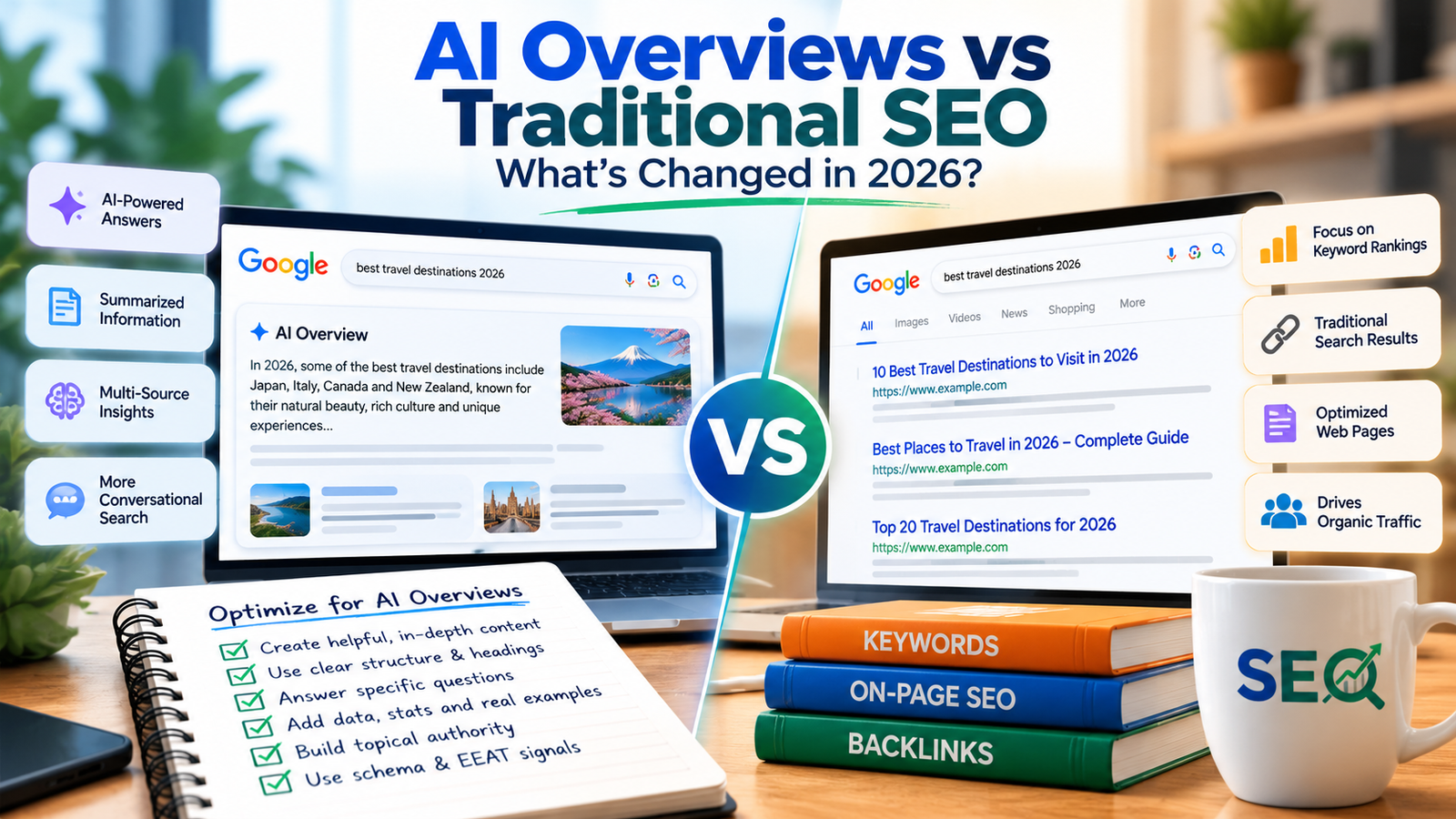
AI Overviews have changed where organic traffic comes from, not whether traditional SEO still matters. Traditional ranking factors — content quality, technical health, backlinks — still determine whether a page gets surfaced at all, including inside an AI Overview. What’s changed is that a growing share of searches now get answered directly on the results page, meaning a page can be the source behind an answer without ever receiving the click it would have gotten in 2022.
If your traffic has started dipping even as your rankings held steady or improved, AI Overviews vs traditional SEO is very likely part of the explanation — not because your SEO stopped working, but because success now sometimes looks different than a click.
AI Overviews are AI-generated summaries that appear directly at the top of Google’s search results for many queries, synthesizing information from multiple sources into a single, direct answer. They draw from existing web content — meaning the SEO fundamentals that get a page indexed and understood in the first place are still the foundation an AI Overview pulls from, rather than something entirely separate from traditional search.
The most significant shift behind AI Overviews vs traditional SEO is the rise of zero-click search — searches where the user gets their answer directly on the results page and never clicks through to any website. This isn’t entirely new; featured snippets created a smaller version of this effect years earlier. AI Overviews have expanded it considerably, since they can synthesize a full, conversational answer rather than just quoting one snippet from one source.
For businesses, this means impressions and visibility can stay strong, or even grow, while click-through traffic for certain types of queries declines — particularly for purely informational searches where a direct answer fully satisfies the searcher.
Yes — and this is worth being direct about, because it’s easy to overstate how much has actually changed. Does traditional SEO still work? The pages that get selected as sources for AI Overviews are still determined by the same underlying signals traditional SEO has always relied on: relevance, authority, technical health, and content quality. AI Overviews haven’t replaced these ranking factors; they’ve added an additional layer on top of them, determining how an already-ranking page’s information gets presented and attributed.
In practice, the sites struggling most in 2026 tend to be the ones that were already weak on SEO fundamentals — AI Overviews have simply made those gaps more visible by removing some of the traffic that previously masked underlying weaknesses.
While the underlying ranking signals remain similar, a few things matter more specifically for being selected as a source within an AI Overview:
The practical shift isn’t abandoning traditional SEO — it’s adding a layer on top of it. Keep investing in the fundamentals (technical health, quality content, backlinks) while also structuring key content specifically for extractability: clear direct answers near the top of a page, genuine FAQ sections, and schema markup that makes a page’s structure explicit to both traditional crawlers and AI systems.
It’s also worth tracking impressions and brand visibility alongside clicks, since a page can be doing real work — building awareness, driving brand searches, supporting AI citations — even during periods where direct click-through traffic for that specific query type has declined.
AI Overviews impact on SEO is likely to keep growing rather than reverse, as AI-assisted search becomes a bigger part of how people search in general, not just a temporary feature. The businesses that adapt fastest tend to be treating this as an evolution of SEO rather than its replacement — keeping the fundamentals strong while adding the structure and credibility signals that help their content get selected and cited, even in a search landscape that’s giving away more answers for free.
Often yes, particularly for purely informational queries where the AI-generated answer fully satisfies the search without requiring a click. Commercial and more complex queries tend to be less affected.
No. The same fundamentals — content quality, technical health, authority — still determine which pages get surfaced and cited, including within AI Overviews. What's changed is how that visibility translates into clicks.
Clear, direct answers near the top of a page, genuine FAQ sections, structured data (schema markup), and established credibility signals all improve the chances of being selected as a cited source.
No — both still matter. Clicks remain important for conversions, but tracking impressions and visibility alongside clicks gives a more complete picture in a search landscape where some visibility no longer results in a click.
It's hard to say with certainty, but the current trend suggests AI-generated summaries will continue expanding across more query types, making it increasingly important for sites to structure content for both traditional ranking and AI extractability.

Grow Your Business with Result-Driven SEO & Digital Marketing Solutions. We Help Brands Increase Rankings, Traffic, and Quality Leads Organically.
| Monday | 9:30 AM - 6:30 PM |
| Tuesday | 9:30 AM - 6:30 PM |
| Wednesday | 9:30 AM - 6:30 PM |
| Thursday | 9:30 AM - 6:30 PM |
| Friday | 9:30 AM - 6:30 PM |
| Saturday | 9:30 AM - 6:30 PM |
| Sunday | Closed |
©Copyright @ 2026 RankPluto. | All Right Reserved
This will close in 0 seconds