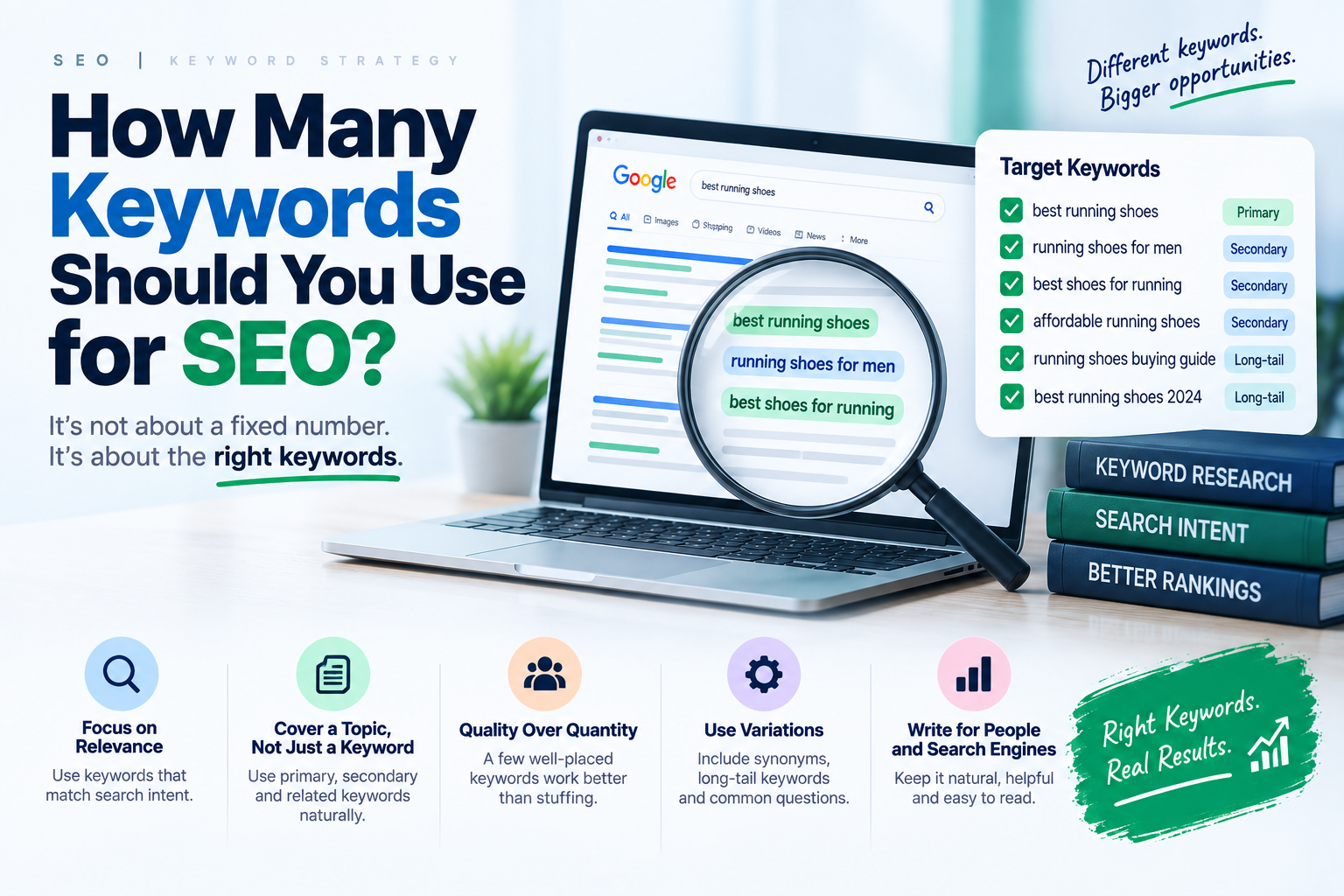
How Many Keywords Should You Use for SEO?
There’s no fixed number. Most well-optimized pages naturally target one primary keyword and 3 to 5 closely related secondary keywords — not a specific count you force into the text. How many keywords for SEO you actually need depends far more on search intent and page length than on hitting a magic number.
If you’ve been told to “use 10 keywords per page” or “repeat your keyword 15 times,” that advice is outdated. Modern search engines read for meaning and relevance, not keyword frequency — and chasing a number instead of writing a genuinely useful page is one of the fastest ways to hurt your rankings instead of helping them.
Why "How Many Keywords" Is the Wrong First Question
Search engines today use natural language understanding to figure out what a page is about — not a simple word count of how many times a phrase appears. A page can rank well by covering a topic thoroughly and naturally, using a handful of related phrases the way a person would actually write them, rather than repeating one exact phrase over and over.
That’s why the better question isn’t “how many SEO keywords should I use,” but “does this page fully answer what the searcher is looking for?” If it does, the right number of keywords tends to take care of itself.
A Realistic Guideline for How Many SEO Keywords Per Page
While there’s no strict rule, here’s a practical structure that works for most content:
- One primary keyword — the main topic the page is built around, used in the title, the introduction, and a couple of times naturally throughout.
- 3 to 5 secondary keywords — closely related terms and natural variations a searcher might use instead (for example, “SEO keyword count” or “keywords per page for SEO” alongside a core term).
- A handful of supporting phrases — related concepts that appear naturally as you explain the topic, without being deliberately inserted.
For a typical 1,000 to 1,500-word article, this usually means the primary phrase appears somewhere between 5 and 10 times total — not because of a rule, but because that’s roughly how often it comes up naturally when you’re actually writing about the topic in depth.
How Many Keywords Should You Use for SEO on Longer Pages?
Longer, more comprehensive pages can naturally support more keyword variety, simply because there’s more room to cover related subtopics. A 2,500-word guide might reasonably touch on 8 to 10 related phrases across different sections, while a 600-word page should stay narrower and more focused. The goal isn’t to hit a target number — it’s to match the keyword coverage to how much ground the content genuinely covers.
What Happens When You Use Too Many Keywords
Trying to force in too many keywords for SEO usually backfires in one of two ways:
- Keyword cannibalization — when you try to rank one page for too many unrelated terms, it often ends up ranking weakly for all of them instead of well for any one.
- Keyword stuffing — repeating a phrase unnaturally to hit a target density makes content harder to read, and search engines are specifically built to recognize and penalize this pattern.
Both problems come from the same root cause: treating keywords as something to insert rather than something that emerges naturally from writing a clear, complete answer to a real question.
What Happens When You Use Too Few
The opposite mistake is being too narrow — writing only about one exact phrase and ignoring the natural variations real people search for. Someone might search “how many SEO keywords to use,” while someone else types “how many keywords per page SEO.” If your content only ever uses one exact phrasing, you miss the searchers using the other. Covering a topic with a few natural variations, rather than one rigid phrase, tends to capture more of the actual ways people search.
A Simple Way to Check Your Keyword Mapping
Before publishing, read the page out loud. If any sentence sounds like it was written for a search engine rather than a person, that’s usually a sign a keyword was forced in rather than woven in naturally. Good keyword mapping should be invisible to the reader — it should just read like a well-written, thorough answer to their question.
Not sure which keywords your business should actually target? [Get a free keyword strategy session with RankPluto →]