
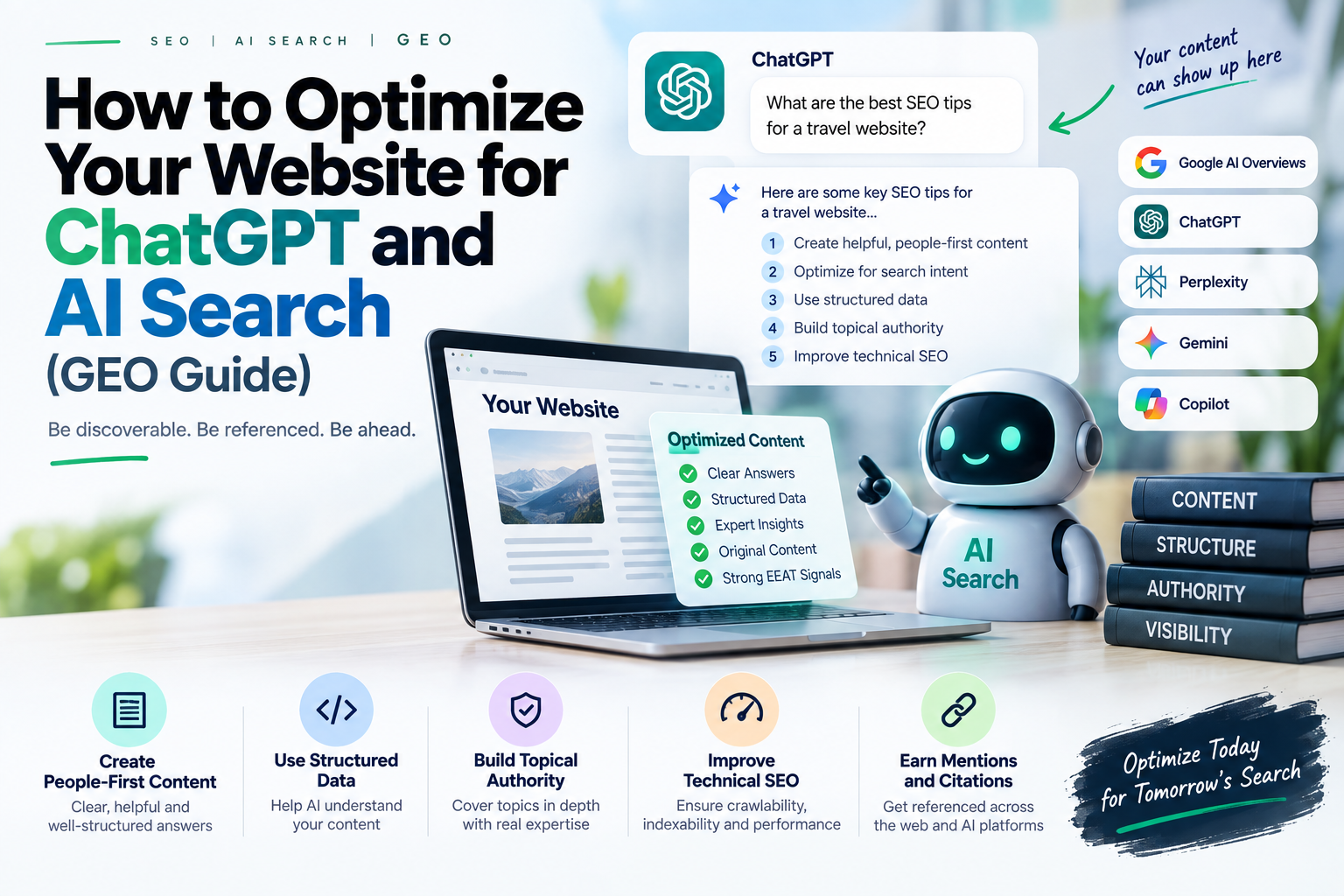
To get your website cited by ChatGPT, Google AI Overviews, and Perplexity, structure your content so AI models can extract clear, direct answers — put the answer at the top of each page, use FAQ sections with real questions people ask, add schema markup, and build genuine third-party mentions and citations. This practice is often called GEO (Generative Engine Optimization), and while it borrows heavily from traditional SEO, it rewards clarity and extractability over keyword density.
If you’ve noticed ChatGPT or Google’s AI Overviews answering questions without ever sending a click to a website, that’s not an accident — it’s because AI models pulled the answer from somewhere, and increasingly, that somewhere is a page built specifically to be understood by a machine, not just ranked by one.
Traditional SEO was built around a simple idea: rank high, get the click. AI search breaks that model. When someone asks ChatGPT or Google’s AI Overview a question, the AI reads several sources, synthesizes an answer, and presents it directly — often without the user ever visiting the source site. Being “rankable” isn’t the same as being “citable.” A page can rank on page one of Google and still never get quoted by an AI model, if the content isn’t structured in a way the model can confidently extract and attribute.
AI search tools don’t read a page the way a human skims it. They look for clear, self-contained chunks of information that directly answer a specific question. A few patterns make content easier to extract:
Every important page should open with a two-to-three sentence answer to the question the page is built around, before any of the usual introduction or backstory. If a page is about “how long does SEO take,” the very first sentences should state the answer — a timeframe, a range, a clear takeaway — not a story about why SEO matters in general. AI models tend to extract from the first clear, complete answer they find, so burying it costs visibility.
FAQs aren’t just good for user experience — they’re one of the most AI-friendly formats that exists, because they already come pre-structured as a question and an answer. The key is using real questions people actually type or ask a voice assistant, not vague, generic ones. “What is local SEO?” gets extracted far more often than a vague heading like “Understanding Local SEO Concepts.” Pair this with FAQPage schema so the structure is explicit to both search engines and AI crawlers.
Schema markup won’t make bad content rank, but it removes ambiguity for good content. FAQPage schema, Organization schema (business name, address, hours, services), and HowTo schema where relevant all give AI models a clean, structured version of your content to pull from — instead of forcing them to parse messy HTML and guess.
AI models weigh how “established” a source appears, and that’s shaped heavily by whether other credible sites reference it. A new website with zero external mentions is far less likely to be treated as a trustworthy source than one referenced across directories, industry publications, or other websites. Getting listed on relevant industry directories, earning genuine backlinks, and being mentioned by other sites all build the kind of credibility that AI models factor into which sources they trust enough to cite.
AI search tools — especially ones like Perplexity that lean on live retrieval rather than a fixed training snapshot — tend to favor recently updated, actively maintained content. A site that publishes consistently and updates older pages when facts change signals that it’s a living, trustworthy source rather than an abandoned one.
GEO isn’t about tricking AI models or stuffing content with keywords hoping something sticks — that approach tends to backfire, since AI models are specifically trained to recognize and discount manipulative, low-quality patterns. The sites that get cited most consistently are the ones that were already trying to genuinely answer a reader’s question clearly. GEO is less a new set of tricks and more a sharper reason to do the things good content always should have done anyway.
GEO is the practice of structuring website content so AI tools like ChatGPT, Google AI Overviews, and Perplexity can easily extract and cite it as a source when answering a user's question — similar to SEO, but optimized for AI extraction rather than just search rankings.
Traditional SEO focuses on ranking high enough to earn a click. GEO focuses on being clear and structured enough that an AI model can confidently extract and attribute an answer, even if the user never visits the site directly.
Yes. FAQ schema gives AI crawlers an explicit, structured version of a question-and-answer pair, which is one of the easiest formats for AI models to extract and cite directly.
It's harder, but not impossible. AI models tend to favor sources with some existing credibility — third-party mentions, backlinks, and consistent publishing all help a newer site build the trust signals AI search relies on.
No. GEO builds on top of solid SEO fundamentals rather than replacing them — clear content, technical health, and authority-building all still matter for both traditional rankings and AI citations.

Grow Your Business with Result-Driven SEO & Digital Marketing Solutions. We Help Brands Increase Rankings, Traffic, and Quality Leads Organically.
| Monday | 9:30 AM - 6:30 PM |
| Tuesday | 9:30 AM - 6:30 PM |
| Wednesday | 9:30 AM - 6:30 PM |
| Thursday | 9:30 AM - 6:30 PM |
| Friday | 9:30 AM - 6:30 PM |
| Saturday | 9:30 AM - 6:30 PM |
| Sunday | Closed |
©Copyright @ 2026 RankPluto. | All Right Reserved
This will close in 0 seconds